


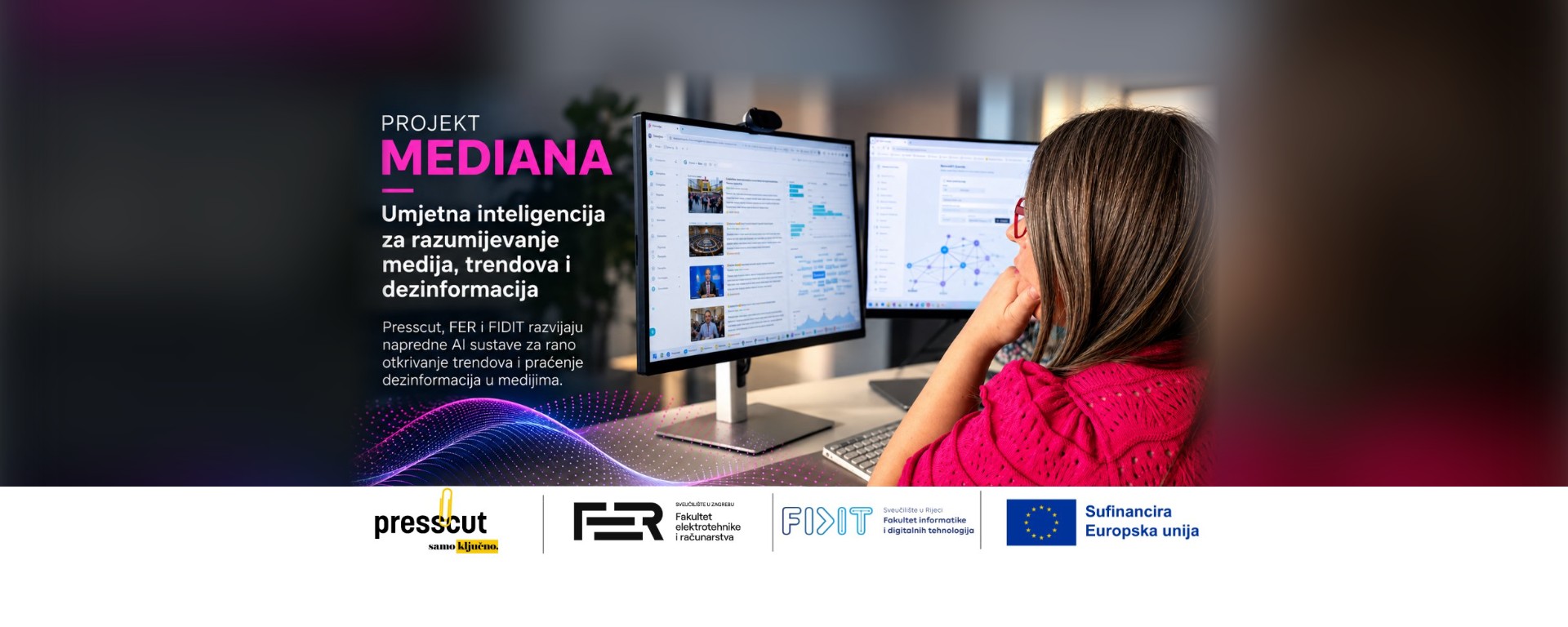
Presscut, FER and FIDIT to Develop Advanced AI Systems for Early Trend Detection and Disinformation Monitoring in the Media
A project worth nearly EUR 1.15 million brings together industry and academia to develop new tools for understanding changes in the media landscape, news content and the context in which it emerges, as well as information sources and dissemination patterns, with a particular focus on analysing content in Croatian and other Slavic languages.
Presscut, a leading regional media intelligence company specialising in media monitoring and analysis, is joining forces with the University of Zagreb Faculty of Electrical Engineering and Computing (FER) and the University of Rijeka Faculty of Informatics and Digital Technologies (FIDIT) on the MEDIANA project. Together, the partners will develop artificial intelligence systems for advanced media content analysis, tracking changes in information and its dissemination, monitoring potential disinformation, and detecting emerging media topics, information sources and actors.

Jasmina Garaj Golubiček, MA in Political Science, President of the Management Board of Presscut, Zagreb:
“MEDIANA is an exceptionally valuable project for Presscut because, through cooperation with leading researchers from FER and FIDIT, it enables us to develop reliable products and services that will advance media monitoring and analysis. Our shared goal is to develop market-ready solutions that will make it easier to extract and process relevant information for our clients, assess its credibility and understand its context, while contributing to a better-informed public and significantly advancing the media intelligence industry.
At a time of rapid advances in artificial intelligence, the opportunity for systematic testing and scientific validation is particularly important to us, enabling us to develop robust systems that can adapt to future technological changes. Cooperation with FER and FIDIT is also a valuable source of knowledge and experience, as well as an opportunity to engage with young researchers and experts. In this way, we are laying a long-term foundation for innovation and for developing the competencies that both our company and the wider industry need.”
Modern Media Challenges
Today’s media landscape is characterised by fragmented information sources, the accelerated production and distribution of content, and the significant influence of digital platforms on audiences’ information consumption habits. Algorithmic ranking and personalisation affect the visibility of information, while journalistic content increasingly overlaps with user-generated posts and content produced using generative artificial intelligence.
This environment makes it more difficult to assess the credibility of sources, distinguish facts from interpretations and understand the broader context. An additional challenge arises when claims move between different media outlets and platforms: their meaning may change, their original source may become obscured, and repeated exposure may create a false impression of corroboration.
Companies, institutions and citizens therefore need more reliable ways to identify relevant information and understand its origins, connections and dissemination patterns.
MEDIANA will explore how artificial intelligence can contribute to analysing these processes, provide a stronger basis for content verification and expert assessment, and support media literacy and informed decision-making. A system that connects content with its sources, relevant actors and the sequence of events would give users a clearer picture of how information originates, evolves and spreads.
For example, when a claim about a company, product or public event appears in different versions, the system should help identify related content and changes in its meaning. Such insights can facilitate the assessment of communication risks, the preparation of appropriate responses and a better understanding of how particular topics shape public debate.
The project will also develop capabilities for detecting entirely new media topics and actors without requiring users to define them in advance. This will be particularly useful for identifying and monitoring emerging trends, detecting changes at an early stage and visualising their development. It will also make it easier to understand how individual claims evolve and identify patterns in their dissemination.
Two Innovative AI Systems
The project will develop two systems based on generative artificial intelligence.
The first will track how false and misleading claims evolve as they spread across the media: how they are reformulated, acquire new contexts or are disseminated by different actors.
The second system will automatically detect and describe previously unseen concepts and topics emerging in the media, such as a new crypto token, a political or social trend, or a new technology, without predefined labels or manual data annotation.
Particular emphasis will be placed on disinformation beyond the political sphere. Economic and industry-related disinformation can undermine trust in companies and institutions and cause direct financial and reputational damage.
Croatia has already witnessed fraudulent advertisements featuring deepfake videos of well-known doctors promoting non-existent medicines, as well as fake video messages impersonating company executives to promote investment scams.

Prof. Ivica Botički, PhD, University of Zagreb Faculty of Electrical Engineering and Computing:
“For years, FER has been a leading institution in Croatia in artificial intelligence research and development, and MEDIANA gives us the opportunity to apply our experience and expertise to one of the greatest challenges of our time: the contemporary media landscape.
We will develop new methods for tracking how media disinformation changes and spreads, and validate the results under controlled laboratory conditions before applying them in practice. Cooperation with Presscut and FIDIT brings together the best of academia and industry, and it is precisely this kind of synergy that leads to solutions with real-world applications.”
Technology Adapted to the Croatian Language
For the media monitoring and analysis industry, the project represents an opportunity to develop more advanced services that will provide users with richer contextual insights for strategic and crisis communication.
Expected outcomes include new analytical methods, structured collections of media content and a prototype system that will be tested and further developed with a view to future commercial application.
The project also has broader societal value. Understanding where information originates, the context in which it was created and the changes it undergoes as it spreads is an important aspect of media literacy.
Visualisations showing how claims evolve and connect with one another can support critical engagement with media content and help identify patterns that require further verification and the debunking of disinformation.
As part of MEDIANA, language technologies and datasets tailored to the specific characteristics of the Croatian language will be developed, with the potential for application to other Slavic languages. In this way, the project will contribute to the development of tools capable of better understanding local media environments and linguistic contexts.

Prof. Ana Meštrović, PhD, University of Rijeka Faculty of Informatics and Digital Technologies:
“At the Semantic Technologies Laboratory at FIDIT, we have been conducting research in artificial intelligence for a number of years, particularly in natural language processing, ranging from sentiment analysis and topic classification to modelling information dissemination.
We are currently exploring applications of generative artificial intelligence across various domains, with one of our research priorities focusing on modelling the evolution and dissemination of information using large language models.
In the MEDIANA project, we will apply this expertise to media texts and develop innovative methods for early trend detection, combining semantic text representations, knowledge graphs and large language models capable of recognising and describing emerging phenomena without predefined categories. These methods will form the foundation of the MEDIANA system’s advanced modules.”
Synergy Between Academia and an Industry Leader
MEDIANA brings together scientific expertise, market experience and user needs through a partnership between organisations recognised in their respective fields.
Presscut contributes decades of experience in developing technologies, methodologies and expertise for collecting, processing and analysing media content, alongside an in-depth understanding of user requirements.
FER and FIDIT, as leading academic and research institutions, contribute the scientific expertise needed to develop new artificial intelligence methods and approaches to content analysis.
Presscut is the project coordinator and is responsible for building a research corpus of media content, experimental development and preparing solutions for commercial application.
FER leads the development of methods for tracking the evolution of disinformation and validating the prototype under laboratory conditions.
FIDIT leads the development of methods for detecting emerging topics and entities, testing the system in a real-world environment and disseminating scientific results.
The project is expected to deliver new products that will enhance media monitoring and analysis services, as well as a dedicated system for tracking disinformation narratives.
The MEDIANA project is scheduled to run for 30 months and is co-financed under the Competitiveness and Cohesion Programme 2021–2027, through the Ministry of Economy and the Croatian Agency for SMEs, Innovations and Investments (HAMAG-BICRO).
Zagreb, October 2026
YOU MAY BE INTERESTED IN

THEY TRUST US








Download the Presscut Mobile app and stay tuned every step of the way.


Komentirajte