


Media coverage analysis of the Croatian wildfires: what 30,000 items show
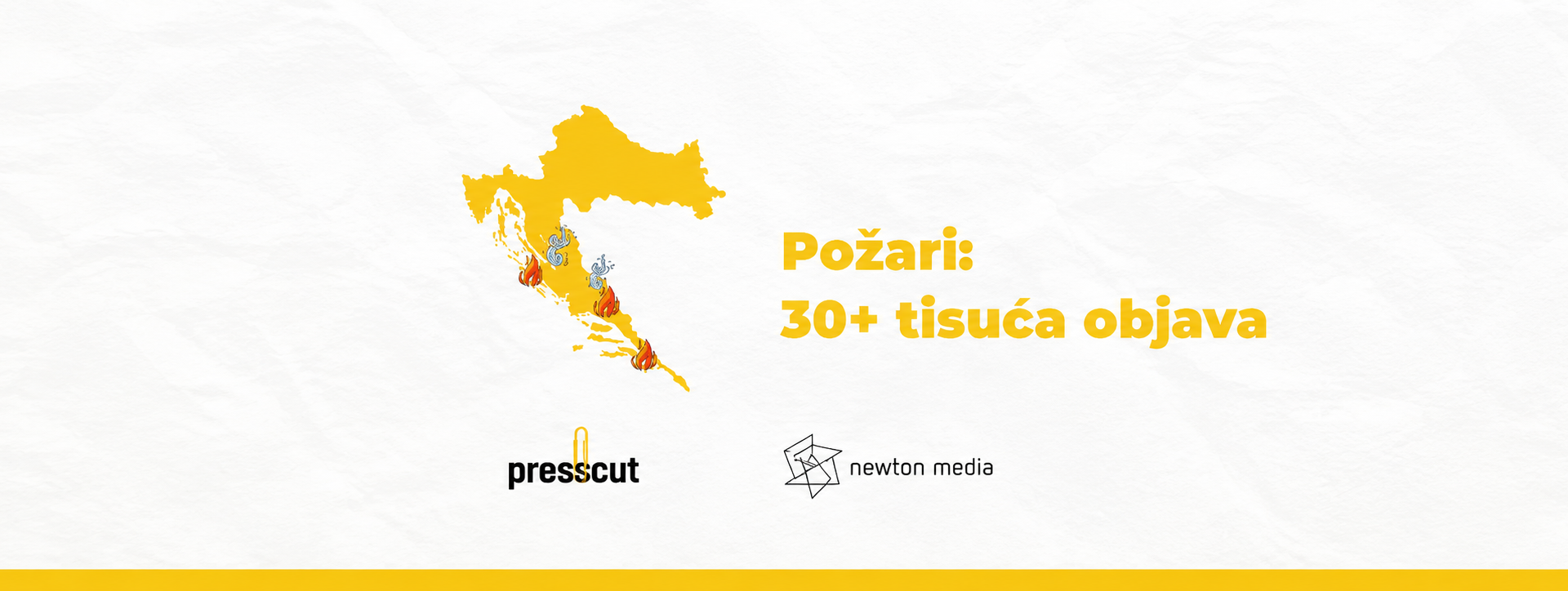
In just seven days, the Croatian media space was flooded with coverage of wildfires: field reports, accounts from people who had left their homes, and the experiences of firefighters. We ran a media coverage analysis on the topic and processed more than 30,000 items from print, radio and television, news portals and social media.
The media coverage analysis showed that the story developed along four clearly separate lines. Here is what we saw — and, at the end, how a picture like this is put together.
What 30,000 items show
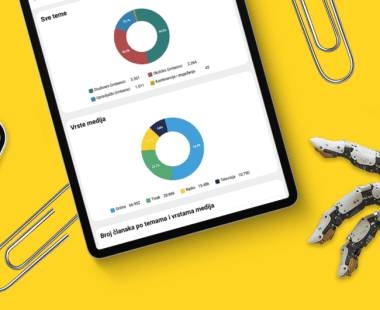
In one week we recorded more than 30,000 items about the fires. Most of the coverage appeared on Facebook and on online news portals, and among the locations the ones that stood out were Omiš, Dugi otok and Pelješac.
The organisations appearing most often as key actors are the Croatian Firefighting Association, the army, the Harbour Master’s Office, the Croatian Mountain Rescue Service (HGSS), the Red Cross and the State Attorney’s Office. That list was not compiled by hand — these are simply the organisations mentioned most frequently across the texts, identified automatically.
Four themes that emerged on their own
The items were not grouped by keywords but by events. Four distinct clusters came out of that grouping.
1. The scale of the damage
A series of fires on the Omiš riviera, Pelješac and Dugi otok affected more than 1,000 hectares. Houses, vehicles, coastal structures and agricultural buildings were destroyed. At least one person died, dozens were seriously injured and thousands were evacuated.
2. Causes and criminal proceedings
In several cases arson or other human action is suspected — from discarded cigarette butts to fireworks. Police and the USKOK anti-corruption office conducted criminal investigations, and several people were arrested in Zadar County, Split and the Benkovac area. Alongside this, the coverage carried calls for tougher penalties and stronger prevention.
3. Rescue and recovery
Firefighters, the army, the Harbour Master’s Office, HGSS, the Red Cross and volunteers evacuated more than 2,000 people, set up reception centres and began emergency recovery work. State officials visited the fire sites and announced financial aid and a longer-term reconstruction of the affected areas.
4. The European context
Comparable fires hit Belgium, Greece, Montenegro, Italy, Germany, France, Spain and the United Kingdom. Foreign media singled out the Croatian fires in particular, along with extreme weather, heatwaves and strong winds.
Why this matters beyond fire season
The wildfires were an exceptional situation, but a media coverage analysis works on the same logic in any crisis. When a topic explodes, the first question is never how many items there are, but how fast it is growing, where it is spreading and whose voices are carrying it.
- Public institutions and local government see in real time where pressure is building and what needs a response.
- Communications and PR teams get tone and themes instead of a raw list of links.
- Companies can separate their own visibility from the noise around an entire category.
Once a crisis passes, comparison is what remains. We archive all Croatian print titles from 1990, and 24-hour recordings of national radio and TV stations from 2007, which means this year’s picture can be measured against previous seasons. More about that on our media archives page, and about measuring tone and topics on the media analysis page.
How this media coverage analysis is produced
A picture like this does not come from reading. It comes from stacking several technologies we have been developing for years.
Breadth of sources. We monitor every daily newspaper, magazine and print title, the national radio and television programmes, and — through Web Hunter — more than 2,000 Croatian news portals in real time. On social media our systems process and store more than 2 million items every day. Without that breadth the figure of 30,000 would mean nothing, because there would be no denominator.
Beey. Television and radio do not arrive as text. Beey transcribes them automatically and identifies speakers, which makes broadcast segments as searchable as a newspaper article.
NERC. The system recognises people, organisations, locations and other entities in text. That is how the list of key actors and locations came about — Omiš, Dugi otok and Pelješac were not predefined search terms, they were the result.
Events. Our event-detection technology groups items that describe the same thing, even when they use different words. It is what reduced 30,000 items to a handful of readable themes.
Classifier. An AI system based on neural networks ranks content by importance, so a report leads with what carries weight.
Finally, our AI assistant Isaac summarised how the story developed day by day, who the main actors were and which locations were written about most. All of this data is also available through an API, so it can be fed straight into your own analytics systems.
You can read more about the technology behind this on the Presscut tech page, and about the service itself on the media monitoring page.
The people behind the numbers
Behind every one of those 30,000 items are people in the field. Our thanks go to the Croatian Firefighting Association, to volunteer fire brigades, to HGSS, to the Croatian Red Cross and to all the organisations and volunteers who spent these days doing work that is not measured in reach.
If you would like to see what an analysis like this would look like for your own topic, get in touch through our contact page or on 0800 600 909.
YOU MAY BE INTERESTED IN

THEY TRUST US






Download the Presscut Mobile app and stay tuned every step of the way.


Komentirajte